
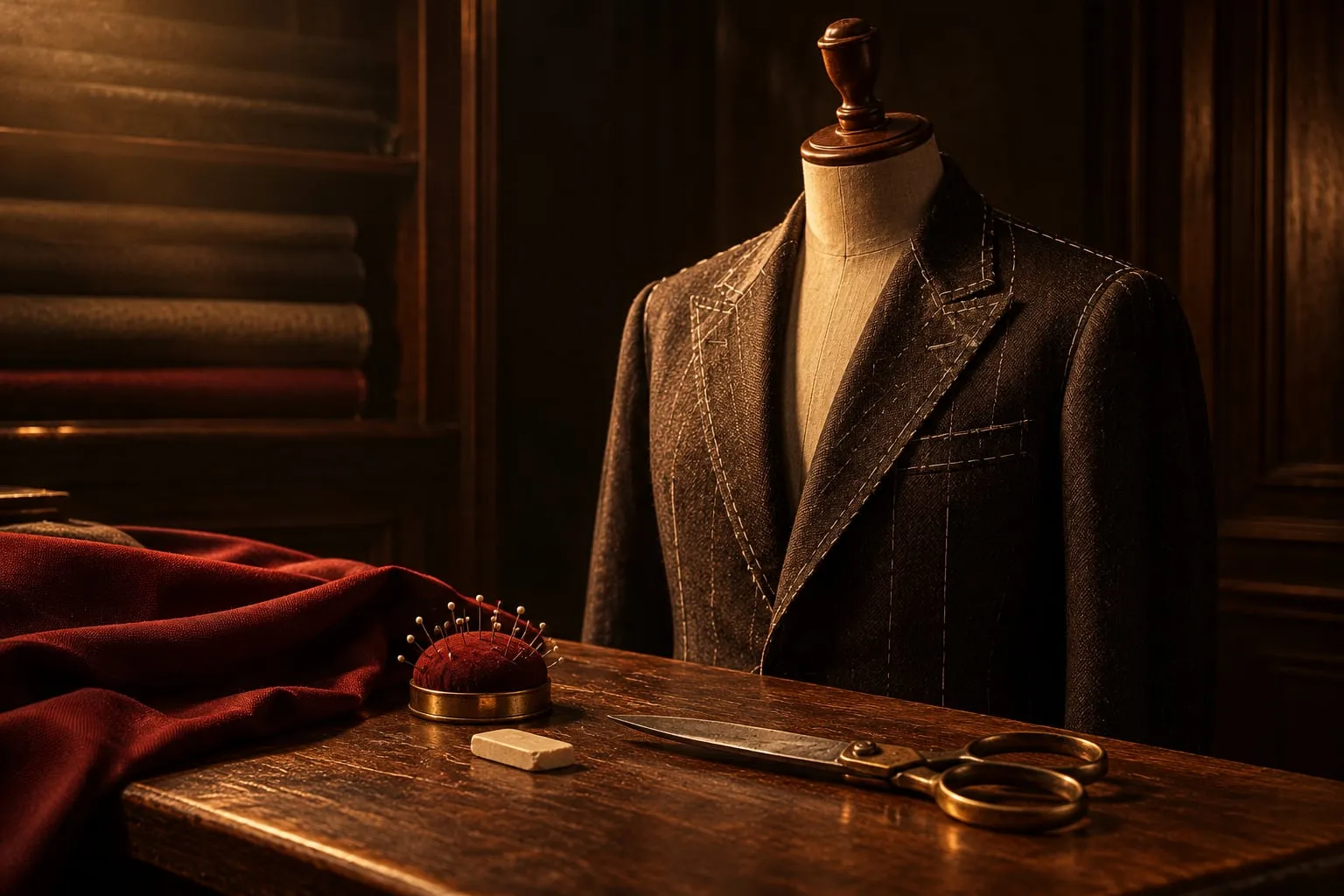
The Suit Gets You in the Door
I never once saw the Don in a creased shirt. He wasn’t a dandy. He simply ran three laundries, and every hotel manager he sat down at a table with could see his collar. “A laundryman in a creased shirt,” the Don used to say, “is working for the competition.” His shirts were pressed by the same women who pressed the hotel sheets. The collar was starched separately, the way it was for every client. For forty years he wore a grey suit. The suits changed; the colour stayed.
His clothes were a sample of the goods. The manager is under no obligation to believe what you tell him about starch. The collar he can see for himself. Straight away.
A Tenth of a Second
In 2006 Janine Willis and Alexander Todorov of Princeton showed people unfamiliar faces and took them away after a tenth of a second. People had time to decide whether this person could be trusted, whether he was competent, whether they liked him. When the face was left up longer, the judgements mostly stayed the same, and the confidence grew. A few did change, admittedly. And notice what was being measured: the impression made by a photograph. Not whether the person is honest in fact. And not what people will say about him after a month of working together.
You’ve been read before you open your mouth. Take care of what gets read. But remember the reverse too: if they read you fast, they had time to get it wrong fast. It shows at once. So does a misreading.
Whose Jacket Are You Wearing
In the spring of 1981 Pistone walked into a Brooklyn club in a brown check jacket he liked to wear in Florida. Sonny Black, the capo he was then working under, told him to throw it out: in it Donnie looked like a hick from out of town. Sonny took him to a salesman he knew who sold off-the-peg clothes, and they bought a couple of jackets and some trousers. That was better, was Sonny’s verdict.
Listen to how Sonny put it: they were smartening Donnie up so that he wouldn’t embarrass Sonny. Sonny. Donnie’s jacket was part of Sonny’s reputation. Once someone has vouched for you, the way you look is no longer only your business.
What Changes in a Day
Even before the Donnie Brasco role, Pistone had worked undercover among the hijackers in Florida. The ringleader, Becker, boasted that he could smell feds a mile off: according to him they dressed a certain way, talked a certain way, behaved a certain way. He boasted about it standing next to a federal agent. He didn’t smell a thing.
Later, getting ready to become Donnie Brasco, Pistone hung rings and chains on himself and bought sporty clothes. It cost him 750 dollars. Becker was half right. You can change your clothes in a day if you have 750 dollars. To change the way you talk and carry yourself takes years, and that’s exactly what people get caught on.
The historian Mike Dash describes Benedetto Madonia, who was murdered in New York in 1903. He dressed better than the working men around him: a suit, a high collar, a tie, good shoes. When asked, Dash writes, Madonia said he was a stonemason. But his well-kept, neatly manicured hands showed not a trace of a craftsman’s calluses. The suit he chose himself. The hands told the rest.
Dash describes the opposite case too. Detective Petrosino dug the ground alongside the labourers. For that, a big cap, a red bandana and a long coat were all he needed. People believed the cap, because nobody was hiding a manicure under it.
Someone Else’s Vocabulary
On their first day in San Diego, Lefty noticed that people dressed differently there. That evening in the hotel bar a good-looking woman kept glancing at Donnie. Pistone said she was working for money. Lefty didn’t believe it: she was too classy, and she wasn’t dressed the part. Pistone told him that in California everybody dresses differently, pal. Lefty insisted she be invited over to their table and went up to his room, supposedly for a nap. A few minutes later it was all cleared up. At first Lefty was indignant: no make-up, a skirt of normal length, how was anyone supposed to tell? Then he laughed at himself. Honestly.
Clothes are a local language. At home you read it without looking. In a strange town your old vocabulary lies to you, and you go on believing it.
Sometimes the vocabulary comes straight from the movies. Saviano writes that after The Godfather young Italian-Americans from the Mafia world put on dark glasses and pinstripe suits and started talking in lines from the film. A suit like that can be read from a long way off. And not only by the people it’s being shown to.
Sneakers and a Smile
You can break the dress code too, but it depends where. In 2014 Silvia Bellezza, Francesca Gino and Anat Keinan of Harvard Business School gave about a hundred and fifty young people, mostly students, a description of an invented professor to read. In one version he wore a tie and shaved. In the other he wore a T-shirt and had a beard. If the professor worked at a top-tier university, the bearded one in the T-shirt was rated higher: students respected him more, he taught better and was stronger in research. If nothing of the sort was said about the university, there was no gain, if anything the reverse. The red sneakers the experiment was later nicknamed after belong to a different experiment, with a real lecturer and a different question.
Notice that what decided it was the setting, not fame. The professor was invented; nobody could have known him. Where the place speaks for itself, breaking the rule can be read as the right to break it. Where it doesn’t, the break adds nothing and may even take something away. First work out where you are, then surprise people.
A face is clothing too, and it gets faked as well. In 1862 the French physician Guillaume Duchenne noticed that in a real smile the muscles around the eyes tighten. On demand they don’t obey well. Better just to look at people calmly.
The Bottom Line
Wear what backs up your trade and your sponsor. For a laundryman, a fresh collar, not an expensive watch. Then your clothes will say first what you’ll say yourself later, and you won’t have to contradict them.
And when you read other people, look at what can’t be bought in a day: hands, speech, habits. And don’t trust your first reading in a strange town: there your vocabulary lies, the way it lied to Lefty. Madonia chose a good suit. The thing to ask about was the calluses.