
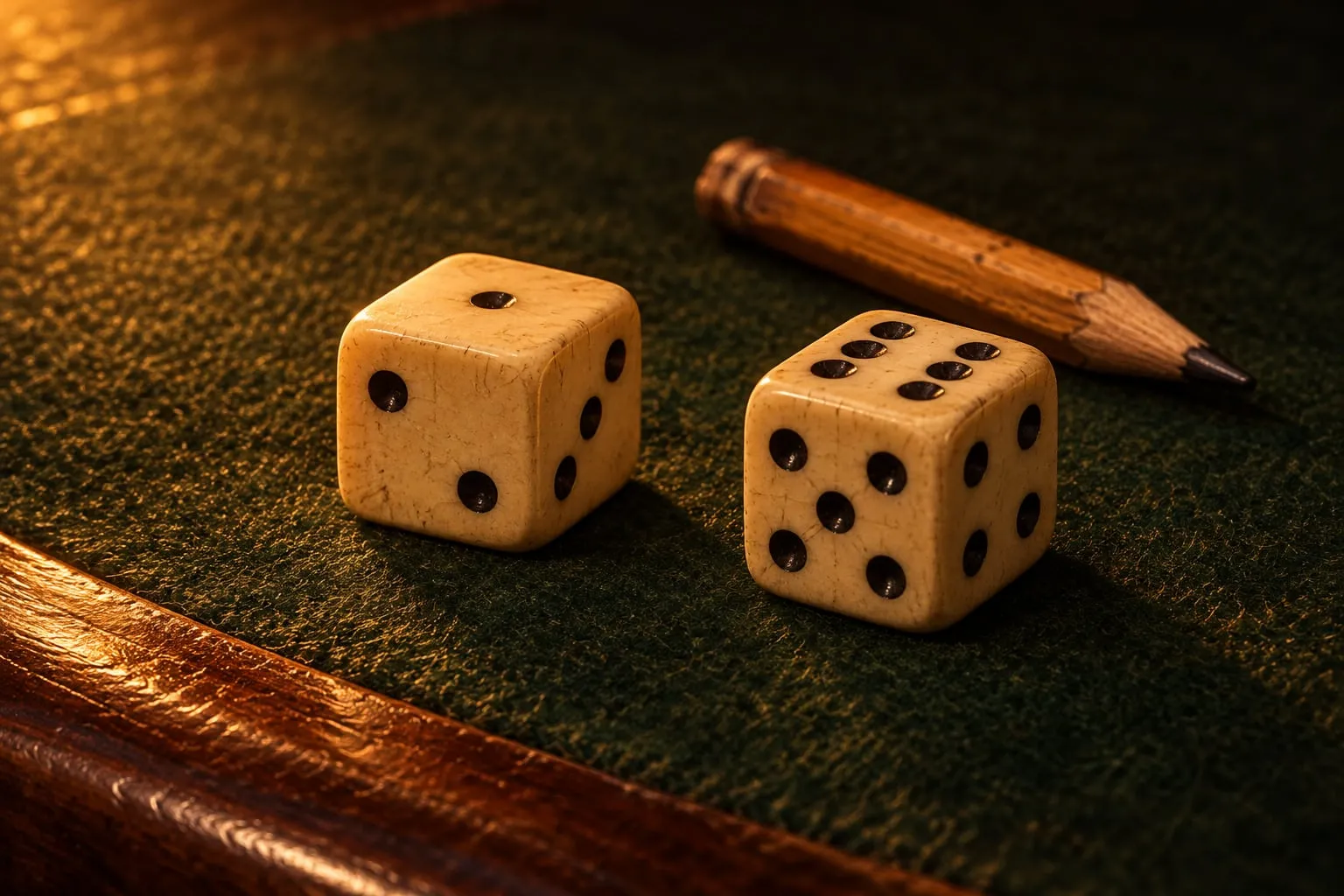
Counting the Odds
In 1654 a French nobleman and keen gambler, the Chevalier de Méré, came to the mathematician Blaise Pascal with a question gamblers had been racking their brains over for centuries. Two men play until one of them wins an agreed number of rounds, with a stake on the table. The game has to be broken off. How do you split the money fairly?
A hundred and sixty years earlier the Italian Luca Pacioli, the father of bookkeeping, had proposed splitting it in proportion to the rounds each man had already won. Sounds sensible. And it’s completely wrong. Pascal wrote to another great mathematician, Pierre de Fermat, about the problem, and between them they found the right answer. You split not by the past but by the future: you look at how many ways each man could still win if the game went on. Out of that correspondence grew probability theory. A gambler asked a question, and out came a science that today no bank, no insurance company and no casino can work without.
The casino, mind you, didn’t make that list by accident.
What Expected Value Is
Remember this term: expected value. You don’t hope, you count. The expected win tells you how much you get on average per game if you play a great many times. The sum is simple: you multiply each possible outcome by its probability and add them up.
Take roulette. You put a dollar on a single number. A European wheel has thirty-seven pockets: thirty-six numbers and the zero. Your number comes up, you win thirty-five dollars. It doesn’t, you lose your dollar. Thirty-six times out of thirty-seven you lose; once you win thirty-five. On average every dollar you stake costs you about three cents. On American roulette, with two zeros, you lose about five.
Those three cents on the dollar are the house edge. In a single game you won’t even notice them. You can win today, tomorrow and the day after. But the casino isn’t playing against you. It plays against everyone, every night, for years. The three cents drip and drip until they grow into palaces in the middle of the desert.
Who Makes the Book
Our people once understood this better than the professors.
Take the numbers racket, which American Mafia families lived off for half a century. The player bets on three digits. One in a thousand guesses right. The usual payout is six hundred to one. Which means that out of every dollar the players bet, the game keeps forty cents on average. Out of that the whole chain still has to be paid. In Cleveland, for instance, the runner who took the bets kept a quarter of the stake, the pickup man a tenth, and the rest went to the counting house, which paid out the winnings and on an ordinary day kept another fifteen cents or so on the dollar.
The legal lotteries of American states today usually keep about half of what’s staked. The illegal game kept between twenty and forty per cent. The state takes more from the player than the Mafia did. So who’s robbing whom? And there’s more: studies showed that when a state brought in its own lottery, people, contrary to expectations, if anything played the illegal one more often. Those who were used to playing simply played more.
Why the Bookie Isn’t Always Rich
So making a book looks like a sure way to get rich? Not quite.
Pistone writes that Lefty, his mentor, ran bookmaking and made his money unevenly: feast one week, famine the next. A couple of weeks back, Lefty complained, he had lost thirteen thousand in a single week. Another time he told him that last week he’d taken in fifty-two thousand in bets and paid out seventeen and a half. One big client, a tailor, bet a hundred and seventy-five thousand a weekend. Pistone reckoned Lefty would make between five and ten thousand on that action. But last season, Lefty admitted, there had been a week when the same client won sixteen off him.
Lefty had the edge. On average he made money. But the average adds up over many weeks, and in any one week a client can hit the big score and eat a month’s profit. For the house to win, it has to survive to the end of a long run. And for that you need a reserve.
There’s a second reason too. Critchley cites researchers: running an illegal game is very expensive, and costs eat up most of the turnover. You have to pay the runners, the pickup men, the muscle, the lawyers, hand out bribes, write off gamblers’ debts that nobody will ever repay. One economic study from 1986 put the net income of the entire illegal gambling business in the United States at a modest four and a half billion dollars a year. For the whole country. For everybody. The house really did win. It’s just that the chain ate most of the winnings. That’s why Mafia crews, Critchley writes, preferred to put gambling money to work—in loan-sharking and hijackings, where the return was higher.
Play, or Be the House
Here’s what I want you to take away from this essay. In any game some people play and others are the house. At roulette, in the lottery, at the races, the player’s expected value is negative and the house’s is positive. Don’t know who’s the house at this table? Then it isn’t you.
Only don’t confuse a casino with every place that takes a commission. The broker takes a cut when you buy, the insurer when you take out cover, the bank when it sells you its product, and each of them gets his share however the cards fall. But that doesn’t yet mean you’re losing. You put money into a business that brings in eight on average, give one to the middleman, and you’re left with seven. Enough for you and for him. That’s an expected value, not a promise: in a bad year there won’t be eight or seven. And a fire policy isn’t a bet at all. You pay so that one bad night doesn’t ruin you, and buying that way can be very sensible.
So ask two questions, and ask them separately. First: who gets his percentage whatever happens, and isn’t it too big? Second: how much is left for me on average once he’s taken his, and what am I risking? If there’s no honest answer to the second question and you buy the ticket or the share anyway because the neighbour said so, you’re paying for entertainment. That’s no sin, as long as you understand it and spend no more than you’re ready to.
Don Vincenzo never gambled. And not out of piety. As a young man he noticed that the owner of the gambling hall in their neighbourhood drove a new car while all his customers went on foot. That was enough for him for life. I once asked him whether he had never wanted to try. He said: “I ran a laundry. Every man who brought me a shirt paid me, whatever happened to him that day. Why would I sit down at a table where somebody else makes his money that way?”
The Bottom Line
A small edge over millions of bets brings in huge money, but only to the one who survives to the end of the run and whose margin the chain hasn’t eaten. And at any table, ask two things: who takes his percentage whatever happens, and what’s left for you on average once he’s taken it.